Fuel Range Planning for Remote Routes
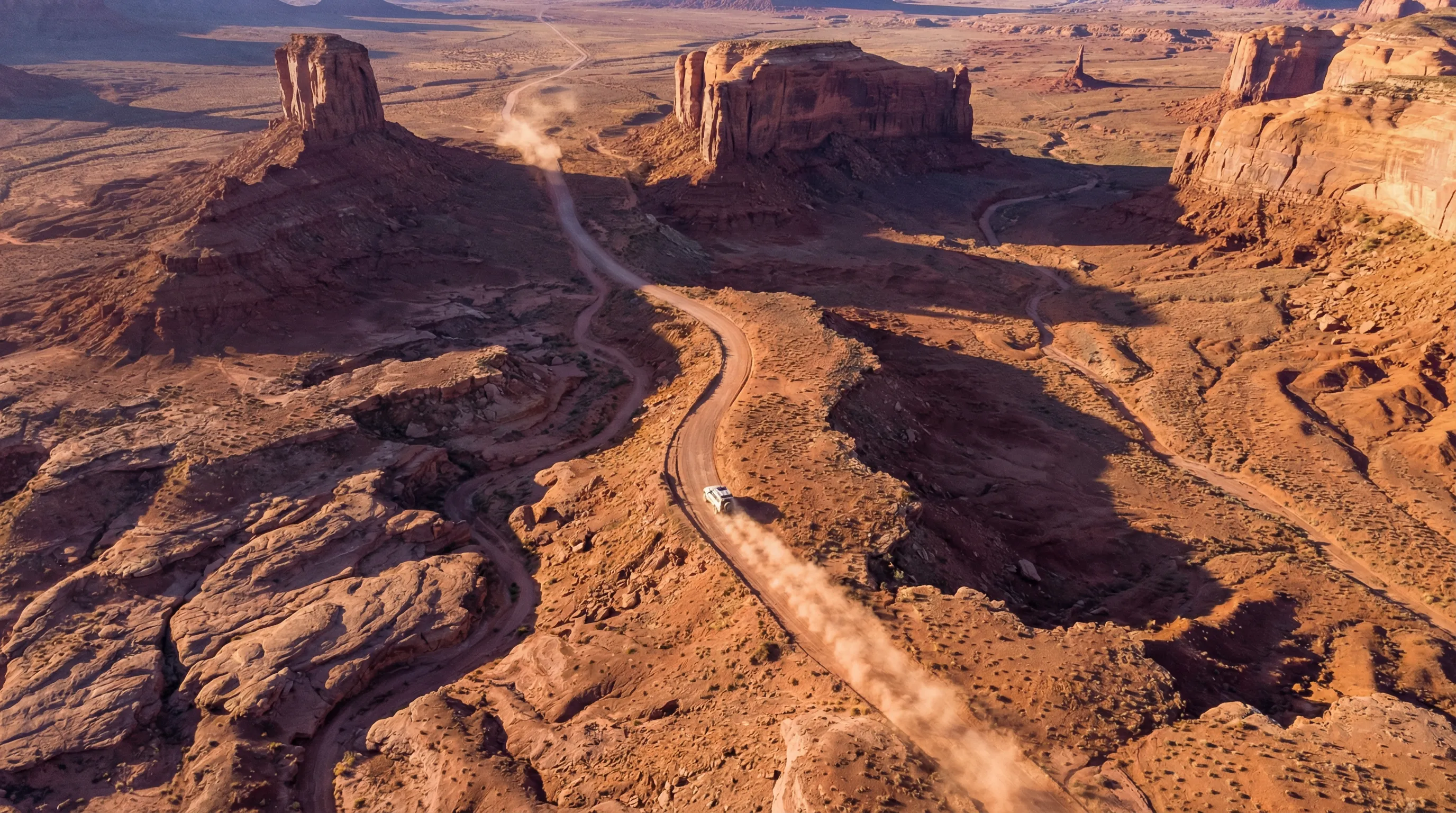
On the gravel road between Solitaire and Sossusvlei in Namibia, there is a hand-painted sign outside a petrol station that reads: “Last fuel for 350 km.” The sign is not exaggerating. In the other direction, toward Walvis Bay, the next station is nearly as far. We arrived at that pump with the fuel gauge showing a quarter tank and the range computer claiming 180 km of range — which, on the gravel road we had been driving, was optimistic by about 40%. We filled up, thanked whatever instinct had kept us from pushing past it, and did the maths that should have been done 400 km earlier.
Fuel range planning is the most underestimated logistic in off-road travel. On paved highways, running low on fuel is an inconvenience. On a desert piste 200 km from anywhere, it is a survival situation. The gap between highway fuel economy and off-road fuel economy is large enough to strand you, and most drivers discover this the hard way — either through a terrifying fuel gauge reading or through a story like ours that ends at a petrol station instead of a satellite phone call.
This guide covers the mathematics, the equipment, and the country-specific realities of keeping your tank full when the next station is a long way away.
Why off-road consumption is different
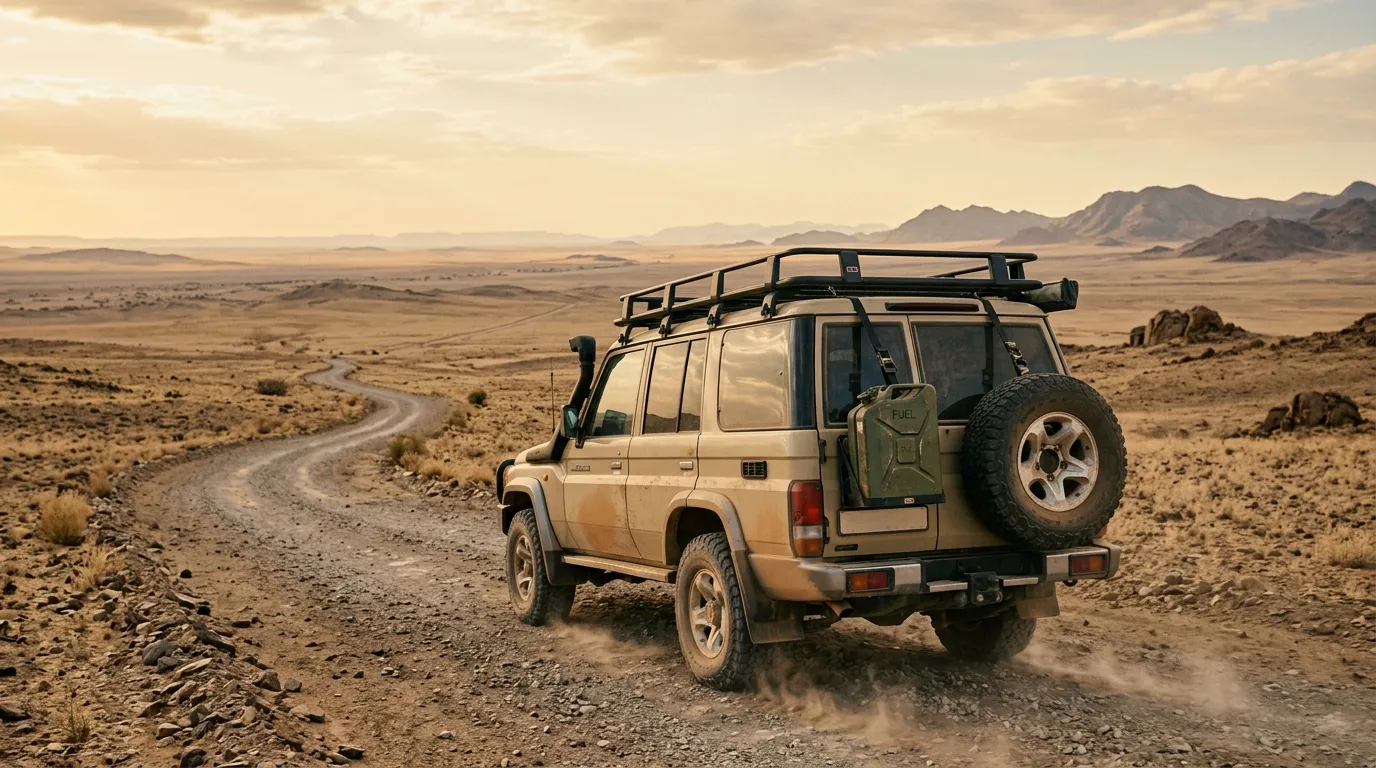
Your vehicle’s manufacturer-quoted fuel economy is measured on smooth pavement at steady speed. Off-road driving violates every assumption behind that number.
Lower speeds, higher RPM. In low-range first gear on a rocky track, your engine might be turning at 3,000 RPM while the vehicle moves at 8 km/h. That is roughly 10 times the fuel consumption per kilometre compared to highway cruising.
Tire pressure. Deflated tires (necessary for sand and gravel) increase rolling resistance. At 18 PSI instead of 35 PSI, rolling resistance increases by roughly 25-40%.
Surface resistance. Sand absorbs energy. Gravel corrugations force constant speed adjustments. Mud requires more throttle input. Rocky terrain demands low gears and high engine braking (descending) or high throttle (ascending).
Elevation changes. Mountain passes consume fuel on the way up. Engine braking on the way down saves fuel, but not enough to offset the climb.
Air conditioning. In desert environments where temperatures reach 40-50 degrees Celsius, running the AC is not optional. AC adds roughly 10-15% to fuel consumption.
Weight. A fully loaded overlanding vehicle — passengers, luggage, water, camping gear, recovery equipment, spare fuel — can be 300-500 kg heavier than the empty kerb weight. More weight means more fuel.
The consumption multipliers
We have logged fuel consumption across hundreds of off-road kilometres in different terrain types. These multipliers represent how much more fuel you use compared to the manufacturer’s highway figure.
| Terrain Type | Consumption Multiplier | Example |
|---|---|---|
| Well-graded gravel (fast travel, 80-100 km/h) | 1.15-1.25x | Namibia B-roads, Morocco N-roads |
| Rough gravel / corrugations (50-70 km/h) | 1.25-1.40x | Namibia C-roads, Iceland highland approaches |
| Ungraded dirt track (30-50 km/h) | 1.35-1.50x | Georgian mountain tracks, Bosnian highland roads |
| Rocky terrain / slow crawl (10-30 km/h) | 1.50-2.00x | Tusheti Road, Sani Pass, Baviaanskloof river sections |
| Sand (deflated tires, 20-40 km/h) | 1.60-2.20x | Wadi Rum, Wahiba Sands, Sahara pistes |
| Deep sand / dunes (15-25 km/h) | 2.00-2.50x | Erg Chebbi, Wahiba interior, Skeleton Coast beach sections |
| Mountain passes (steep ascent) | 1.50-2.00x | Tizi n’Test, Transalpina, Abano Pass |
How to use these: Take your vehicle’s manufacturer highway consumption (e.g., 9 L/100km for a Toyota Hilux diesel) and multiply by the relevant factor. On rough gravel at 1.35x, your real consumption is roughly 12.2 L/100km. On sand at 2.0x, it is 18 L/100km.
The calculation
Here is the formula we use for every remote route:
Step 1: Know your tank size.
| Vehicle | Approximate Tank Size (L) |
|---|---|
| Suzuki Jimny | 40 |
| Dacia Duster | 50 |
| Toyota RAV4 | 55 |
| Mitsubishi Pajero | 88 |
| Toyota Hilux (double cab) | 80 |
| Toyota Land Cruiser Prado | 87 |
| Toyota Land Cruiser 300 | 110 |
Step 2: Estimate your off-road consumption.
Take the highway consumption and multiply by the terrain factor.
Example: Toyota Hilux diesel, highway consumption 9 L/100km, driving on rough gravel (multiplier 1.35).
Off-road consumption = 9 x 1.35 = 12.15 L/100km.
Step 3: Calculate your range.
Range (km) = (Tank size in litres / Consumption per 100 km) x 100
Hilux example: (80 / 12.15) x 100 = 658 km on rough gravel from a full tank.
Step 4: Apply a safety margin.
Never plan to use more than 75% of your calculated range. The remaining 25% is your reserve for detours, getting lost, backtracking, or conditions being worse than expected.
Usable range = 658 x 0.75 = 493 km on rough gravel.
Step 5: Compare to the distance between fuel stops.
If the distance between fuel stations is less than your usable range, you are fine. If it is more, you need extra fuel.
When the maths do not work
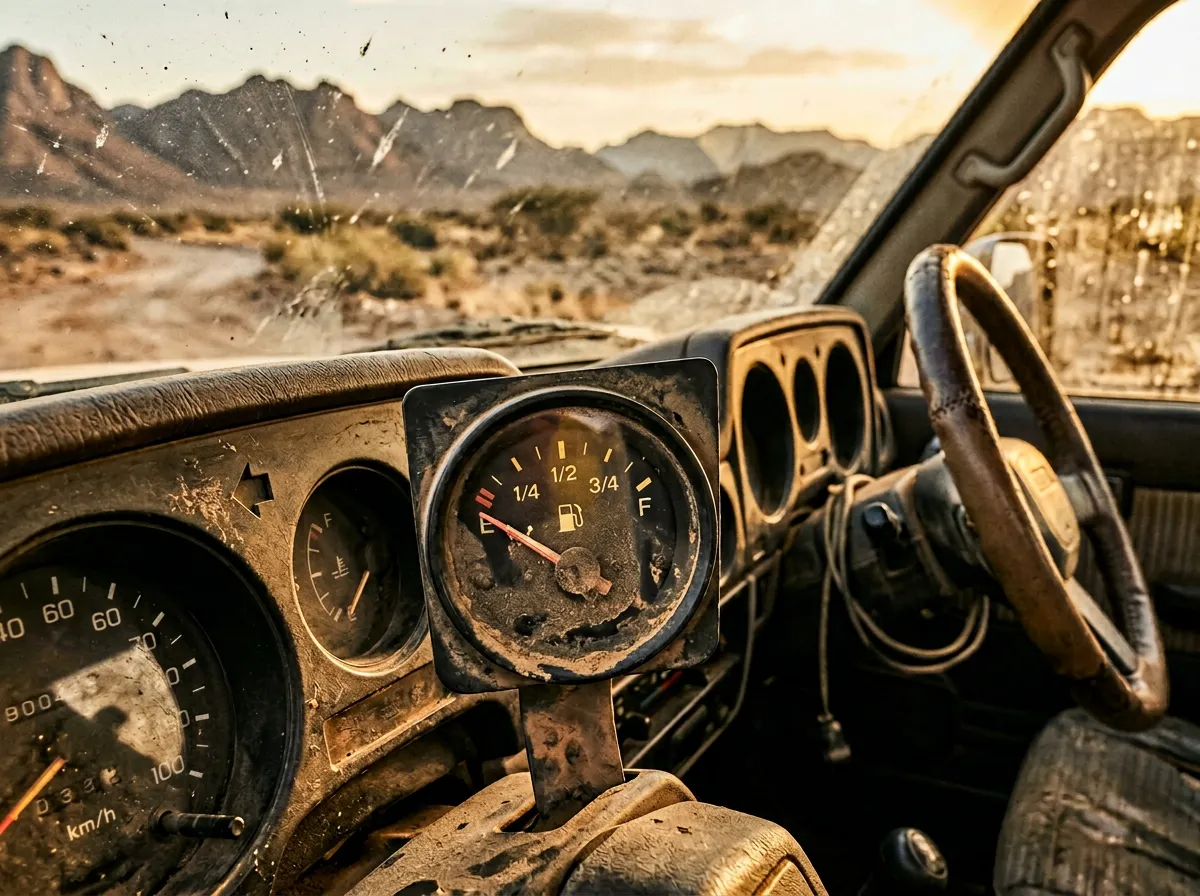
On some routes, the distance between fuel stations exceeds even a Land Cruiser’s range. The Skeleton Coast in Namibia. The Sahara piste from Merzouga to Zagora. The Sprengisandur crossing in Iceland. Parts of the Simien Mountains circuit in Ethiopia. When the maths say you cannot make it on one tank, you have two options: carry extra fuel, or do not do the route.
We recommend carrying extra fuel.
Jerry cans: types, mounting, and safety
Metal vs. plastic
Metal (steel or aluminium). More durable, more resistant to puncture, and rated for long-term fuel storage. Steel jerry cans in the classic NATO design (the rectangular 20L can with the three-handle top) are the gold standard. Aluminium cans are lighter. Both are legal for fuel transport in every country we cover.
Plastic (HDPE). Lighter, cheaper, and easier to find. Many rental overlanding companies in Namibia and South Africa provide plastic jerry cans as part of the vehicle kit. They are adequate for short-term fuel storage (days, not weeks) but more susceptible to damage and can degrade in extreme heat.
Our choice: Metal for any trip where we need reliable extra fuel. Plastic as a backup or for short routes where the extra fuel is a precaution rather than a necessity.
Capacity
Standard jerry can sizes: 5L, 10L, 20L. For most routes, one or two 20L cans are sufficient. The maths:
| Vehicle | Tank (L) | 1x 20L Can | 2x 20L Cans | Extra Range (rough gravel, L/100km at 12) |
|---|---|---|---|---|
| Suzuki Jimny | 40 | 60 total | 80 total | +167 km / +333 km |
| Dacia Duster | 50 | 70 total | 90 total | +167 km / +333 km |
| Toyota Hilux | 80 | 100 total | 120 total | +167 km / +333 km |
| Land Cruiser Prado | 87 | 107 total | 127 total | +167 km / +333 km |
Each 20L can adds approximately 167 km of range at 12 L/100km off-road consumption. Two cans add 333 km. For most fuel gaps on our routes, one 20L can provides an adequate safety buffer.
Mounting
Roof rack. Common but not ideal. A full 20L jerry can weighs 16-18 kg. On the roof, it raises the centre of gravity, increases roll risk on cambered roads, and is difficult to lift down when full. Acceptable for one can; two on the roof makes the vehicle noticeably top-heavy.
Rear-mounted jerry can holder. The best solution for dedicated overlanding vehicles. Bolted to the rear bumper or spare tire mount. Keeps weight low. Common on Hilux and Land Cruiser setups in Namibia and South Africa.
Inside the vehicle. Legal in some countries, illegal in others, and always unpleasant. Fuel vapour in the cabin is a health hazard and a fire risk. If you must carry fuel inside, use a properly sealed container, ventilate the vehicle, and never store it near heat sources or electrical equipment. We avoid this whenever possible.
Strapping to the rear. Some travellers strap jerry cans to the outside of the rear door or tailgate with ratchet straps. This works but check that the strapping is absolutely secure — a 20L can bouncing off the vehicle at speed is dangerous for you and for anyone behind you.
Safety rules
- Fill jerry cans at a petrol station, not from the vehicle’s tank. Siphoning is slow, wasteful, and sometimes triggers anti-theft fuel systems.
- Label the jerry cans if you carry both petrol and diesel. Misfuelling a diesel engine with petrol causes catastrophic damage. Colour coding: green for petrol, black or yellow for diesel, blue for water. Use tape or paint if the cans are the same colour.
- Store cans out of direct sun when possible. Fuel expands in heat and can leak from the cap.
- When refuelling from a jerry can, use a flexible pour spout. Pouring from a 20L can without a spout wastes fuel and soaks your hands.
- Never refuel near an open flame, while smoking, or near the exhaust. This seems obvious. We have seen people ignore it.
Country-specific fuel availability
Fuel station spacing varies enormously between the countries we cover. Here is a summary for off-road route planning.
| Country | Longest Fuel Gap (Our Routes) | Fuel Quality | Notes |
|---|---|---|---|
| Jordan | ~120 km (Wadi Rum interior) | Good | Fill up in Wadi Rum village or Aqaba |
| Georgia | ~80 km (Tusheti Road) | Good in towns, variable in rural areas | Socar and Gulf stations are reliable |
| Iceland | ~300 km (Sprengisandur F26) | Excellent | Highland fuel stops limited to 2-3 stations. Fill at lowland towns. |
| Albania | ~60 km (mountain routes) | Acceptable | Avoid unmarked roadside sellers (adulterated fuel) |
| Montenegro | ~50 km (Sinjajevina) | Good | Short distances; fuel gaps are manageable |
| South Africa | ~200 km (Baviaanskloof) | Good | Fill at Graaff-Reinet or Willowmore before Baviaanskloof |
| Namibia | ~350 km (Skeleton Coast to Damaraland) | Good | Fuel at major towns is reliable. Carry extra for any route north of Sesriem. |
| Tanzania | ~150 km (Ruaha western areas) | Variable | Fuel quality outside major towns can be poor. Filtered fuel from drums at village shops is common in remote areas. |
| Ethiopia | ~200 km (Simien approaches) | Variable | Fuel shortages occur. Stations in small towns may be dry for days. Carry extra always. |
| Morocco | ~250 km (Sahara pistes) | Good on main routes | Desert towns (Merzouga, Zagora, M’hamid) have fuel. Between them, nothing. |
| Oman | ~180 km (Wahiba Sands to coast) | Excellent | Adnoc stations are everywhere on main roads. Desert interior has nothing. |
| Romania | ~40 km (Carpathian forest tracks) | Good | Short fuel gaps. No issues. |
| Bosnia | ~45 km (highland tracks) | Good | Short fuel gaps. No issues. |
Ethiopia: a special case
Ethiopia deserves extra emphasis because fuel logistics there are genuinely difficult. Fuel shortages are periodic and regional — a station that had fuel yesterday may not have it today. The Simien Mountains circuit can involve fuel gaps of 200+ km on roads where consumption is 1.5-2x highway rates. We carried two 20L jerry cans on our Simien route and used both. Without them, we would have been stranded somewhere above 4,000 metres with no cell signal and a long walk to the nearest village.
Ethiopia protocol: Fill your tank and all jerry cans at every opportunity. Do not pass a fuel station, even if your tank is three-quarters full. If the station has fuel, buy it. If it does not, ask when the next delivery is expected and plan accordingly.
Namibia: the gravel highway factor
Namibia’s gravel roads are long, straight, and temptingly fast. The combination of 80-100 km/h speeds, corrugation vibration, and headwinds means fuel consumption is higher than most people expect. A Toyota Hilux that does 8 L/100km on South African tar will do 11-13 L/100km on Namibian gravel at speed. Add headwind (common on the Skeleton Coast) and consumption can hit 14-15 L/100km.
Namibia protocol: Calculate range using 12-13 L/100km as your base gravel consumption, not the manufacturer’s highway figure. Carry at least one 20L jerry can for any route between Sesriem and the coast, or between Damaraland and Skeleton Coast.
The reserve rule
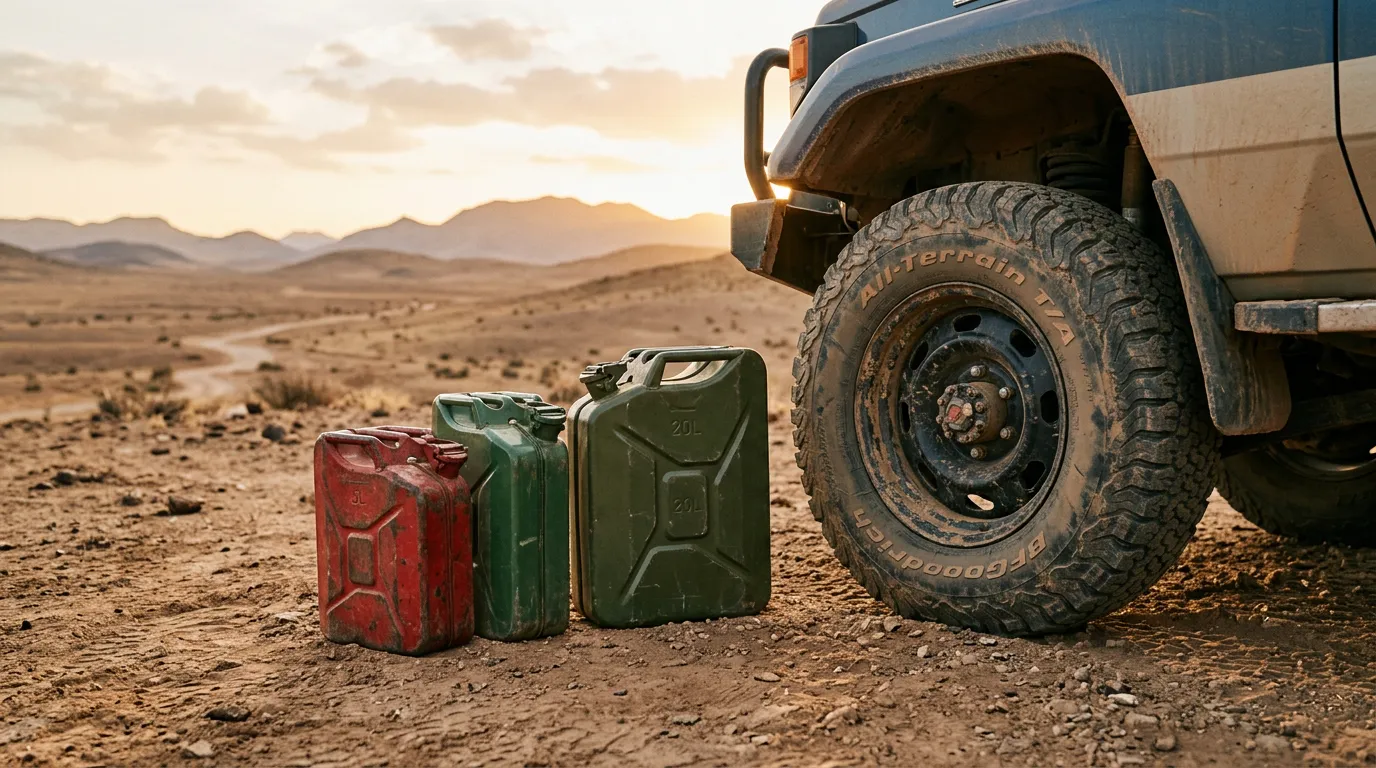
We operate on a simple rule: never let the fuel level drop below a quarter tank. A quarter tank is your reserve. It is not for driving — it is for emergencies, detours, and the realisation that the fuel station you were counting on is closed, dry, or does not exist.
On routes where the next fuel stop is uncertain (Ethiopia, interior Namibia, Sahara pistes), we extend this to one-third tank as the reserve.
This sounds conservative. It is meant to be. We have never been stranded for fuel. We know people who have.
Fuel consumption logging
For your first trip in any vehicle, we recommend logging actual fuel consumption for the first few hundred kilometres. The process:
- Fill the tank completely at a fuel station. Note the odometer reading.
- Drive your planned terrain for 200-300 km.
- Fill the tank completely again. Note the litres added and the new odometer reading.
- Calculate: (Litres added / Distance driven) x 100 = L/100km.
This gives you the real-world number for that vehicle on that terrain, which is more useful than any table or multiplier. If the number is worse than expected, recalculate your range and adjust your fuel plan.
We log consumption for the first two days of every trip and adjust our plans accordingly. The numbers often surprise us — usually in the wrong direction.
Fuel quality issues
Not all fuel is equal, and in some countries the fuel available at remote stations is noticeably worse than what you find in cities.
Contaminated fuel. Fuel stored in drums (common at small village stations in Tanzania and Ethiopia) can contain water, sediment, and other contaminants. Water in diesel causes injector damage and power loss. Sediment clogs filters. If you must buy drum fuel, use a chamois cloth or a fuel filter funnel to filter it as you pour.
Low octane. Petrol in some African countries is 91 octane or lower. Modern turbocharged petrol engines are designed for 95+ octane and will knock, lose power, and potentially damage the engine on low-octane fuel. Diesel vehicles are not affected by this issue — one of the many reasons diesel is preferred for off-road travel.
Adulteration. In a few countries (parts of Ethiopia, rural Tanzania), fuel is occasionally diluted with kerosene or other substances. The signs: reduced power, unusual exhaust smell, engine knocking. There is no easy way to test for this at the roadside. Buy from branded stations when possible. In remote areas, ask other travellers which stations they trust.
Diesel vs. petrol for off-road
If you have a choice of fuel type at the rental counter, choose diesel. The reasons are practical:
- Range. Diesel engines are 20-30% more fuel-efficient than equivalent petrol engines. On a long remote route, that efficiency translates directly to additional range.
- Torque. Diesel engines produce more torque at low RPM, which is exactly what you need for crawling over rocks, climbing steep grades, and pulling through sand.
- Availability. In Africa and the Middle East, diesel is more widely available in remote areas than petrol. Trucks run on diesel, and where trucks go, diesel follows.
- Safety. Diesel is less volatile than petrol. It does not ignite from a spark the way petrol does, making jerry can storage somewhat less hazardous.
The main diesel disadvantage is cold starting at high altitude — at 4,000+ metres in Ethiopia or at sub-zero temperatures in Iceland, diesel can gel if it does not contain winter additives. This is rarely an issue with rental vehicles, which are maintained for local conditions, but it is worth knowing.
Range planning in practice: a worked example
Let us plan the fuel logistics for the Merzouga to Zagora Sahara piste in Morocco — one of the longest fuel gaps on our routes.
Route: Merzouga to Zagora via the desert piste (N12 to off-road to N9).
Distance: Approximately 350 km by the main piste route (not including detours).
Terrain: Mix of rocky piste (60%), sand tracks (30%), and short paved sections (10%).
Vehicle: Toyota Land Cruiser Prado, diesel, 87L tank.
Highway consumption: 10 L/100km (manufacturer).
Off-road consumption estimate:
- Rocky piste at 1.4x: 14 L/100km for 210 km = 29.4L
- Sand tracks at 1.8x: 18 L/100km for 105 km = 18.9L
- Paved sections at 1.0x: 10 L/100km for 35 km = 3.5L
- Total estimated consumption: 51.8 litres
Range check: 87L tank / 51.8L consumption = enough fuel for 1.68x the route distance. With 25% reserve (65L usable), we have 65 / 51.8 = 1.25x margin. That is tight.
Decision: Carry one 20L jerry can. Total fuel: 107L. Estimated consumption: 51.8L. Margin: 107 / 51.8 = 2.06x. Comfortable.
Contingency: If consumption is worse than estimated (sandstorm, getting stuck, major detour), the extra 55L of margin covers roughly 300 additional km of mixed terrain driving. That is more than enough to find fuel or retreat to Merzouga.
This is the process for every remote route. The numbers change; the method does not.
The fuel planning checklist
Before departing on any route with fuel gaps over 150 km:
- Know your tank size (not the range computer estimate — the actual tank size in litres)
- Calculate your off-road consumption using terrain multipliers
- Calculate your range with 25% reserve
- Compare range to distance between fuel stations
- If range is insufficient, carry jerry cans to close the gap
- Fill tank and jerry cans at the last reliable fuel station
- Log actual consumption for the first 200 km and recalculate if necessary
- Know the location of every fuel station on and near your route (mark them on your offline map)
- In Ethiopia, fill at every station regardless of tank level
Running out of fuel is entirely preventable. It requires arithmetic, not heroism. Do the maths before you leave, carry the margin you need, and you will never have to discover what “Last fuel for 350 km” feels like when your gauge is blinking.
| Choosing the right rental vehicle | Driving essentials and recovery gear | Insurance for dirt roads |