David Gareja Desert Loop
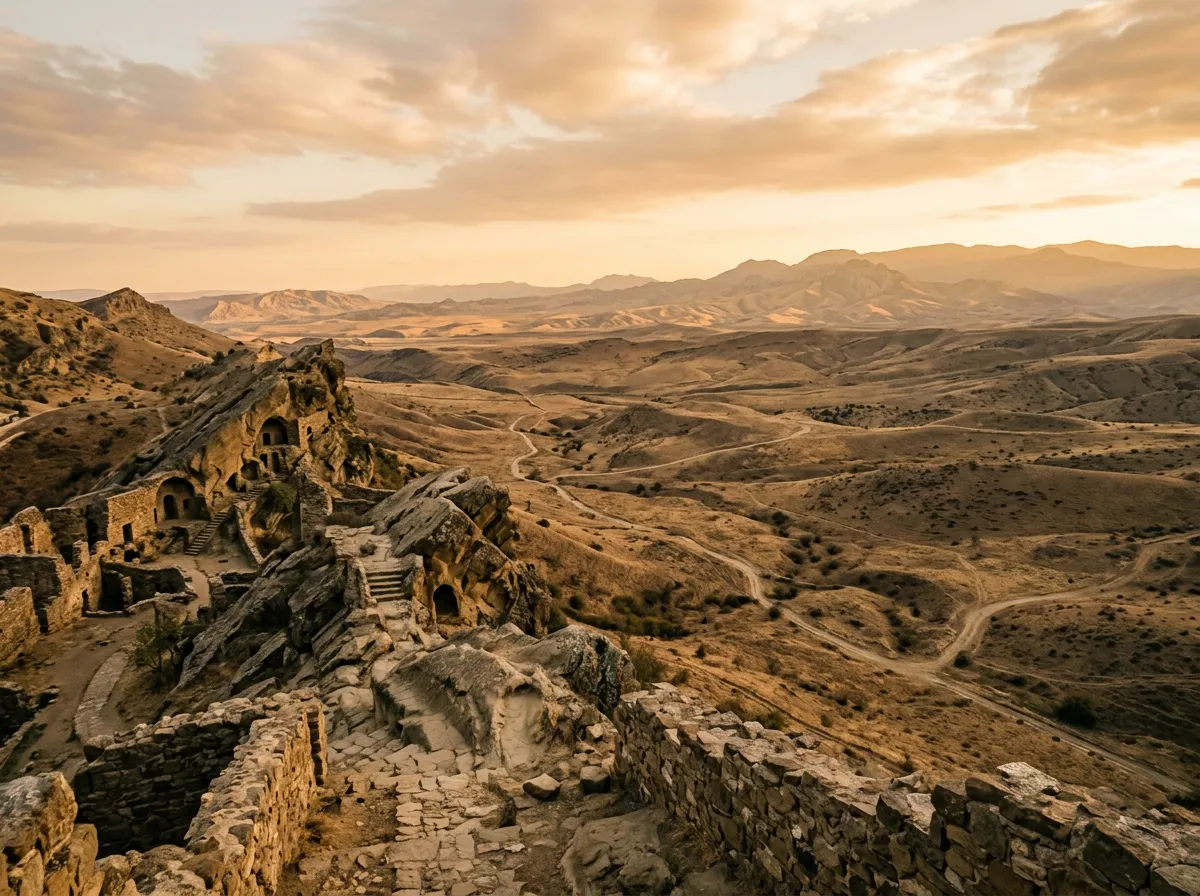
Georgia contains multitudes, and one of the more unexpected ones is a semi-desert. An hour and a half southeast of Tbilisi, the green Caucasus foothills give way to brown, rolling steppe — treeless, sparsely vegetated, and populated mainly by sheep, shepherds, and a sixth-century cave monastery complex that has no business being as extraordinary as it is. David Gareja is where we take people who say they have seen Georgia. They have seen Tbilisi, they have seen the mountains, they have seen the wine region. They have not seen this. Nobody expects Georgia to have a desert.
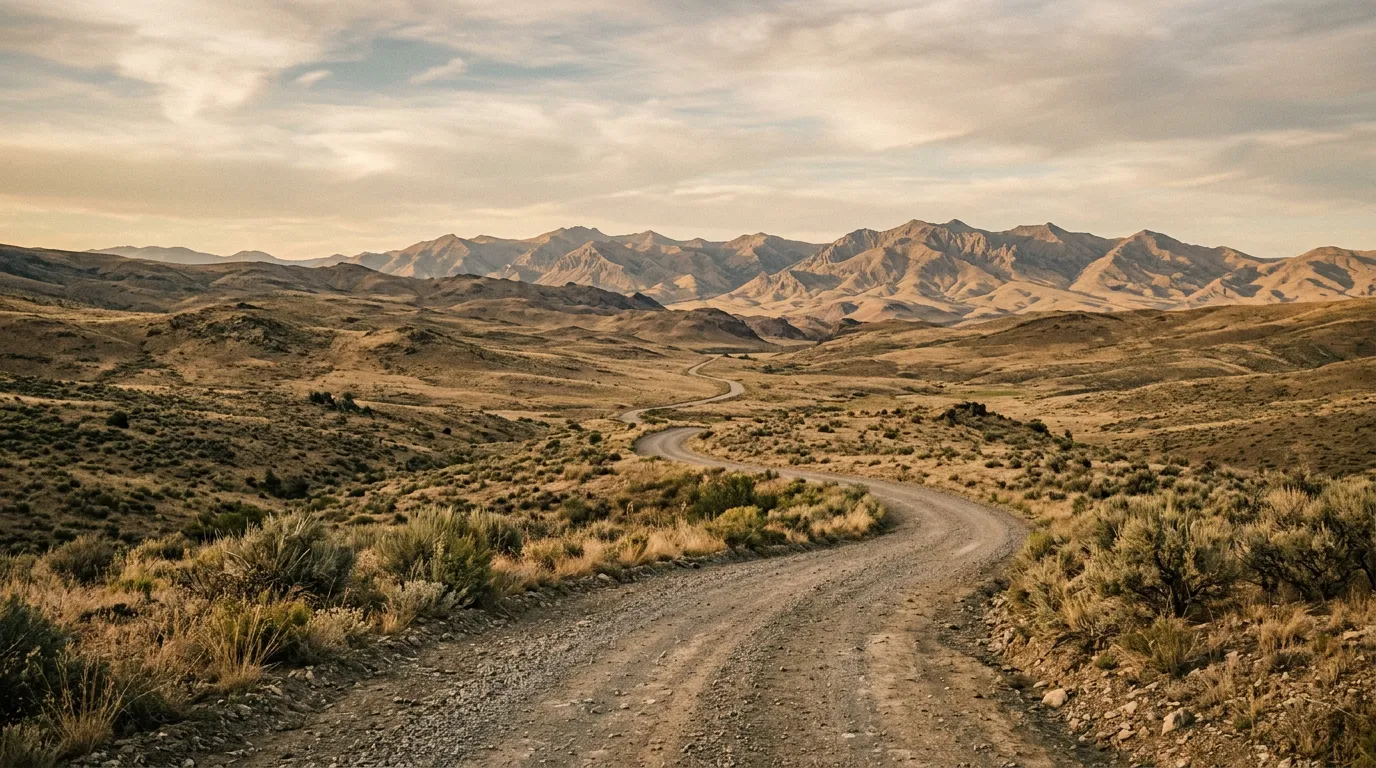
The drive is easy. We are using that word deliberately and without qualification, which is rare for us. A high-clearance 2WD handles the entire route. The road is gravel and dirt, flat to gently undulating, with no river crossings, no cliff edges, no switchbacks, and no sections that require a conversation about tire pressure or recovery straps. This is, by every metric except distance from pavement, a simple drive. It is also one of the most visually striking half-day routes we know, because the landscape is otherworldly and the monastery is a genuine marvel, and the combination of the two in a country primarily known for mountains and wine catches you off guard in the best possible way.
Route overview
The loop runs from Tbilisi southeast through Sagarejo to the David Gareja monastery complex, and returns the same way. The total distance is approximately 100 km each way from Tbilisi, of which 60 km is gravel and dirt from Sagarejo to the monastery.
| Segment | Distance | Elevation | Terrain | Time |
|---|---|---|---|---|
| Tbilisi to Sagarejo | 40 km | 500m – 600m | Paved highway | 45 min |
| Sagarejo to Udabno village | 30 km | 600m – 700m | Gravel road, good condition | 40 min |
| Udabno to David Gareja | 30 km | 700m – 800m | Dirt track, steppe | 45 min |
| David Gareja site (walking) | 2 km | 800m – 850m | Footpath | 1.5–2 hrs |
| Return (same route) | 100 km | — | — | 2 hrs |
Total driving time: approximately 4.5 hours. Total including monastery visit: 6–7 hours. This is comfortably a day trip from Tbilisi with an early start.
The drive out: Tbilisi to David Gareja
Tbilisi to Sagarejo (km 0–40)
The highway east from Tbilisi is fast, paved, and forgettable. You pass through Rustavi — Georgia’s second city, an industrial town that contributes nothing to the scenic experience — and continue to Sagarejo, a small town on the edge of the Kakheti wine region. Sagarejo is your last opportunity for fuel, food, and water. There is a fuel station on the main road that we have used three times without issue. There is also a small shop for snacks and water.
Fill your tank. The round trip from Sagarejo to David Gareja and back is approximately 120 km. A full tank in any modern vehicle covers this easily, but starting a desert drive on half a tank offends our principles.
Sagarejo to Udabno (km 40–70)
The paved road ends shortly after Sagarejo. The gravel begins without ceremony — one moment asphalt, the next compacted gravel with occasional potholes. The road is maintained, more or less, and in dry conditions the surface is firm enough for a regular car to manage at low speed. We recommend a vehicle with some ground clearance because the potholes are sometimes deep enough to matter, and because the approach to the monastery has a few sections of loose dirt where clearance provides confidence.
The landscape changes as you leave the agricultural lowland. The vineyards and orchards give way to brown grass, sparse scrub, and gently rolling hills that extend to the horizon in every direction. This is the Iori Plateau — a semi-arid steppe that receives less than 400mm of rain per year and looks, on a hot afternoon, like a plausible location for a Western film set in a country that never made Westerns. The light is different here than in the mountains. It is flat and harsh and makes the hills look like objects placed on a table rather than features of a landscape.
Sheep are the primary traffic hazard. Flocks of several hundred move across the road at intervals, accompanied by shepherds on horseback or foot and dogs of uncertain breed but definite purpose. The etiquette is to stop and wait. The sheep will pass. The shepherd will nod. The dog will look at you as if assessing whether you are a threat to the flock and concluding, on balance, that you are not.
Udabno to David Gareja (km 70–100)
Udabno is a village that exists mainly as a reference point for people heading to the monastery. There is a guesthouse, a small shop, and not much else. The road beyond Udabno deteriorates slightly — more dirt, less gravel, a few washboard sections that rattle the dashboard. Nothing difficult, just mildly uncomfortable. The steppe opens up further, and on clear days you can see the ridge that marks the Azerbaijan border, running east-west along the horizon like a geological sentence about where Georgia ends and somewhere else begins.
The monastery complex appears on your left as you approach the ridge — a cliff face pockmarked with cave openings, with the main monastery building at its base. There is a parking area (dirt, unmarked, obvious) and a footpath to the monastery entrance. The drive is over. The walking begins.
David Gareja monastery complex
The complex was founded in the sixth century by David, one of the Assyrian Fathers — a group of monks who came to Georgia from Mesopotamia to spread Christianity. David chose this cliff in the semi-desert, which suggests either a profound commitment to ascetic isolation or a deeply questionable real estate advisor. The result is a cave monastery carved into the rock face that has survived 1,500 years of weather, invasions, Soviet demolition orders, and a border dispute with Azerbaijan that technically continues to this day.
The main monastery (Lavra)
The main complex sits at the base of the cliff and is still an active monastery — monks live and worship here. The buildings are a mix of cave cells, stone-built chapels, and more recent construction. The courtyard is quiet and well-maintained. Photography is generally permitted in the courtyard but restricted inside the chapel. The monks are reserved but not unfriendly.
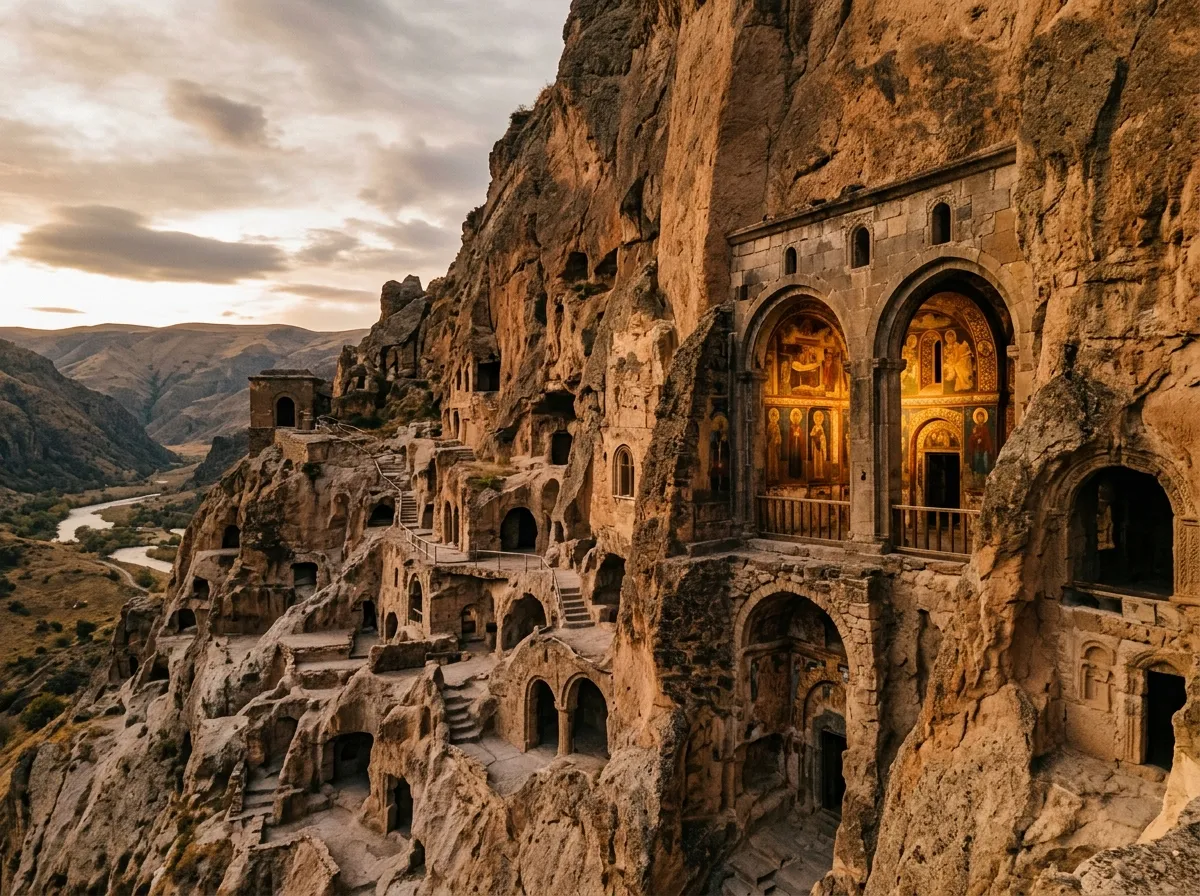
The cave cells are carved into the soft sandstone of the cliff face. Some are simple rectangular rooms. Others have arched ceilings, niches for icons, and traces of painted decoration. The scale is impressive — the complex extends for several hundred metres along the cliff, with cells at multiple levels connected by carved staircases and narrow passages.
Udabno caves (the painted caves)
The real treasure is on the other side of the ridge. A footpath climbs from the main monastery over the ridge and descends slightly to the Udabno cave complex — a series of cave cells containing painted frescoes dating from the 10th to 13th centuries. The frescoes depict biblical scenes, saints, and geometric patterns in reds, greens, and ochres that have survived eight centuries of exposure to the elements.
The quality of the painting is extraordinary. These are not crude folk-art decorations — they are accomplished works of Byzantine-influenced art, executed in a cave monastery in the Georgian semi-desert by monks who had access to pigment, skill, and an apparently unlimited tolerance for difficult working conditions. Some caves retain near-complete programmes of painting across ceilings and walls. Others have fragments — enough to show what was there, enough to make you regret what was lost.
The ridge walk to the Udabno caves is approximately 1 km each way and involves a climb of about 50 metres. It is not strenuous, but in summer heat it is thoroughly uncomfortable. Carry water. Wear a hat. The ridge itself offers views into Azerbaijan — brown steppe extending to the east, identical to the Georgian side, differentiated only by the border markers and the geopolitical reality that you should not cross them.
Practical information
Vehicle requirements
| Requirement | Detail |
|---|---|
| Drivetrain | 2WD sufficient, AWD comfortable |
| Ground clearance | 170mm+ recommended for potholes |
| Tires | Standard road tires adequate |
| Fuel | Full tank from Sagarejo. No fuel at monastery. |
This is genuinely one of the few routes on our site where a rental agency would not object to the vehicle’s destination. A Dacia Duster, Hyundai Tucson, or similar crossover handles the route without drama. We have seen regular cars (Opel Astra, Toyota Yaris) at the monastery parking area. They looked dusty but undamaged.
Fuel and supplies
Last fuel: Sagarejo (40 km from Tbilisi, 60 km from the monastery). The round trip from Sagarejo is 120 km — well within any vehicle’s range on a full tank. There is nothing between Sagarejo and the monastery: no fuel, no shops, no water, no services of any kind. Pack accordingly.
| Item | Recommendation |
|---|---|
| Water | 2L per person minimum. 3L in summer. |
| Food | Snacks for the day. No restaurants at the monastery. |
| Sun protection | Hat, sunscreen, sunglasses. The steppe offers zero shade. |
| Footwear | Walking shoes for the monastery visit. The ridge path is rocky. |
Timing and heat
Start early. We cannot emphasise this enough for summer visits. The drive from Tbilisi to the monastery takes approximately 2 hours. If you leave at 7:00, you arrive at 9:00, when the temperature is still tolerable. By noon in July and August, the steppe temperature exceeds 40 degrees Celsius and the exposed ridge walk to the Udabno caves becomes a test of determination rather than a pleasant excursion.
The optimal schedule:
| Time | Activity |
|---|---|
| 7:00 | Leave Tbilisi |
| 7:45 | Fuel stop in Sagarejo |
| 9:00 | Arrive at David Gareja |
| 9:15 – 10:00 | Explore main monastery (Lavra) |
| 10:00 – 11:30 | Ridge walk to Udabno caves and back |
| 11:30 – 12:00 | Return to car |
| 12:00 – 14:00 | Drive back to Tbilisi |
This gets you back to Tbilisi by early afternoon, in time for a late lunch and a shower and a feeling of mild amazement that a place like David Gareja exists 90 minutes from a capital city.
Season
| Season | Temperature | Road condition | Notes |
|---|---|---|---|
| Spring (April – May) | 15–25°C | Good, occasionally muddy | Wildflowers on the steppe. Best season. |
| Early summer (June) | 25–35°C | Dry, firm | Good conditions, manageable heat |
| High summer (July – August) | 35–42°C | Dry, dusty | Very hot. Early morning visits only. |
| Autumn (September – October) | 18–28°C | Dry, good | Excellent conditions. Warm but not brutal. |
| Winter (November – March) | 0–12°C | Variable, possible mud | Accessible but monastery visit is cold and windy |
The border situation
David Gareja sits on the Georgia-Azerbaijan border, and the border itself runs along the ridge above the monastery. The ridge walk to the Udabno caves approaches the border closely. Do not cross the ridge onto the Azerbaijan side. There are no fences or barriers, but there are border markings, and the border is monitored. This is not a political statement — it is a practical warning. The border area has been disputed between Georgia and Azerbaijan for decades, and while the monastery side is firmly Georgian, the situation is sensitive enough that crossing the ridge invites attention you do not want.
The drive back
The return drive is the same route in reverse. The steppe looks different in afternoon light — warmer, more golden, less harsh — and you will probably drive faster because you know the road. The gravel sections that felt uncertain on the way out will feel routine on the way back. This is the nature of easy routes: the uncertainty is in the unfamiliarity, not the terrain.
We stopped in Sagarejo on the return for fuel and a coffee. The town felt lush and green after the steppe, which is not an adjective we would normally apply to Sagarejo but which the human eye applies to anything with trees after three hours in semi-desert.
From here
David Gareja is the gentlest of our Georgia routes. If the steppe driving and the monastery have whetted your appetite for more challenging Georgian terrain, the Tusheti road is the opposite end of the difficulty spectrum — cliff-edge mountain driving at its most extreme. The Jvari Pass to Mestia route offers a middle ground: mountain passes and medieval towers at a moderate difficulty level, with the option of extending to Ushguli.