Ngorongoro Rim Tracks
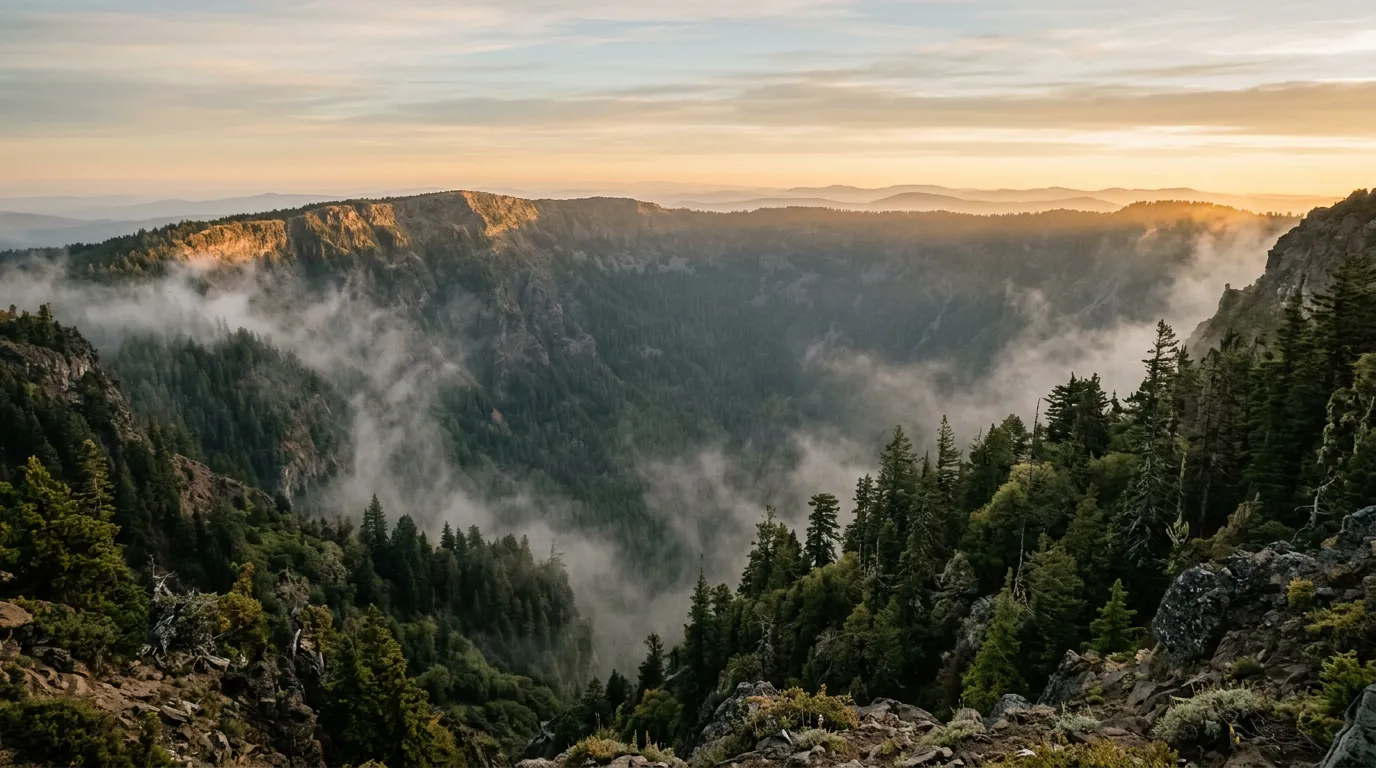
The fog arrived without warning. One moment we were driving through montane forest on the crater rim with reasonable visibility — mossy branches, glimpses of the caldera floor 600 metres below — and the next moment the windscreen was blank white. Not reduced visibility. Not haze. White. A wall of moisture that condensed on the glass faster than the wipers could clear it and turned the forest road into a tunnel of nothing.
We slowed to approximately 10 km/h, which felt too fast for the conditions and too slow for the fact that we were on a single-lane track with no shoulder and a theoretical cliff edge somewhere to our left. The GPS showed us on the rim road. The altimeter read 2,340 metres. The temperature gauge outside showed 14 degrees Celsius, which was 22 degrees cooler than Arusha had been four hours earlier. A Cape buffalo materialized from the fog approximately eight metres ahead of the vehicle — a black shape the size of a small truck, standing in the centre of the track and regarding our headlights with the particular stillness of an animal that has never needed to move for anything in its life. We stopped. The buffalo stared. After a period that felt like several minutes and was probably thirty seconds, it turned and walked into the forest with the deliberate pace of something that weighs 900 kg and knows it.
This is Ngorongoro in the morning: vertical, cold, wet, and populated by animals that consider the road surface their property. The crater — 19 km across, 600 metres deep, the largest intact caldera in Africa — sits inside a conservation area that also contains montane forest, highland grassland, and some of the most extraordinary road driving in East Africa. The tracks that ring the rim and descend to the crater floor are not long, but they are unforgettable.
Route overview
The Ngorongoro driving experience consists of three distinct sections: the approach from the Lodoare Gate to the rim, the rim road that connects the various viewpoints and descent points, and the crater floor circuit. The total distance is approximately 65 km, but the driving time is 6-8 hours including stops, wildlife viewing, and the mandatory waiting time at the descent gate.
| Section | Distance | Terrain | Elevation | Key features |
|---|---|---|---|---|
| Lodoare Gate to crater rim | ~18 km | Graded gravel, forest road | 1,800m → 2,400m | Climbing through montane forest, elephant zone |
| Rim road (east to west) | ~12 km | Packed earth, muddy patches | 2,300m – 2,400m | Viewpoints, lodge access, descent/ascent gates |
| Descent to crater floor | ~5 km | Steep graded track | 2,400m → 1,800m | One-way descent, switchbacks, dense forest |
| Crater floor circuit | ~25 km | Savanna tracks, soft edges | ~1,800m | Lake, hippo pool, Lerai Forest, open plains |
| Ascent from crater floor | ~5 km | Steep graded track | 1,800m → 2,400m | One-way ascent, different route from descent |
The descent and ascent roads are separate one-way tracks. You go down on one road and come up on another. This is not optional — the tracks are genuinely too narrow for two-way traffic on the gradients involved, and the park enforces the one-way system with gates and occasional checks.
Lodoare Gate to the rim
The approach
The main entrance to the Ngorongoro Conservation Area (NCA) is Lodoare Gate (3.3517° S, 35.5033° E), approximately 35 km from the town of Karatu on a paved road. At the gate, you pay the NCA entry fee ($70 per person per 24 hours as of 2026, plus $40 vehicle fee) and the separate crater descent fee ($295 per vehicle — a number that causes visible pain when you hear it for the first time). The fees are payable by Tanapa card or, occasionally, by credit card. Cash is not accepted. Load your Tanapa card in Arusha or Karatu.
From the gate, the road climbs through montane forest for 18 km to the crater rim. The surface is graded gravel — reasonably maintained, occasionally potholed, and slippery when wet. The forest is dense, the canopy closes over the road in places, and the light drops to a cathedral dimness that makes the moss-covered trunks and epiphyte-draped branches feel like a set from a film about prehistoric Earth.
This forest section is elephant territory. The NCA supports a population of approximately 300 elephants, and they use the forest roads as their preferred travel routes. We encountered a family group on the approach road — a matriarch, three females, and two calves crossing the track at a pace that suggested infinite time. The standard procedure is the same as with all Ngorongoro wildlife: stop, switch off the engine, wait. Elephants have right of way. This is not a regulation — it is physics.
Arriving at the rim
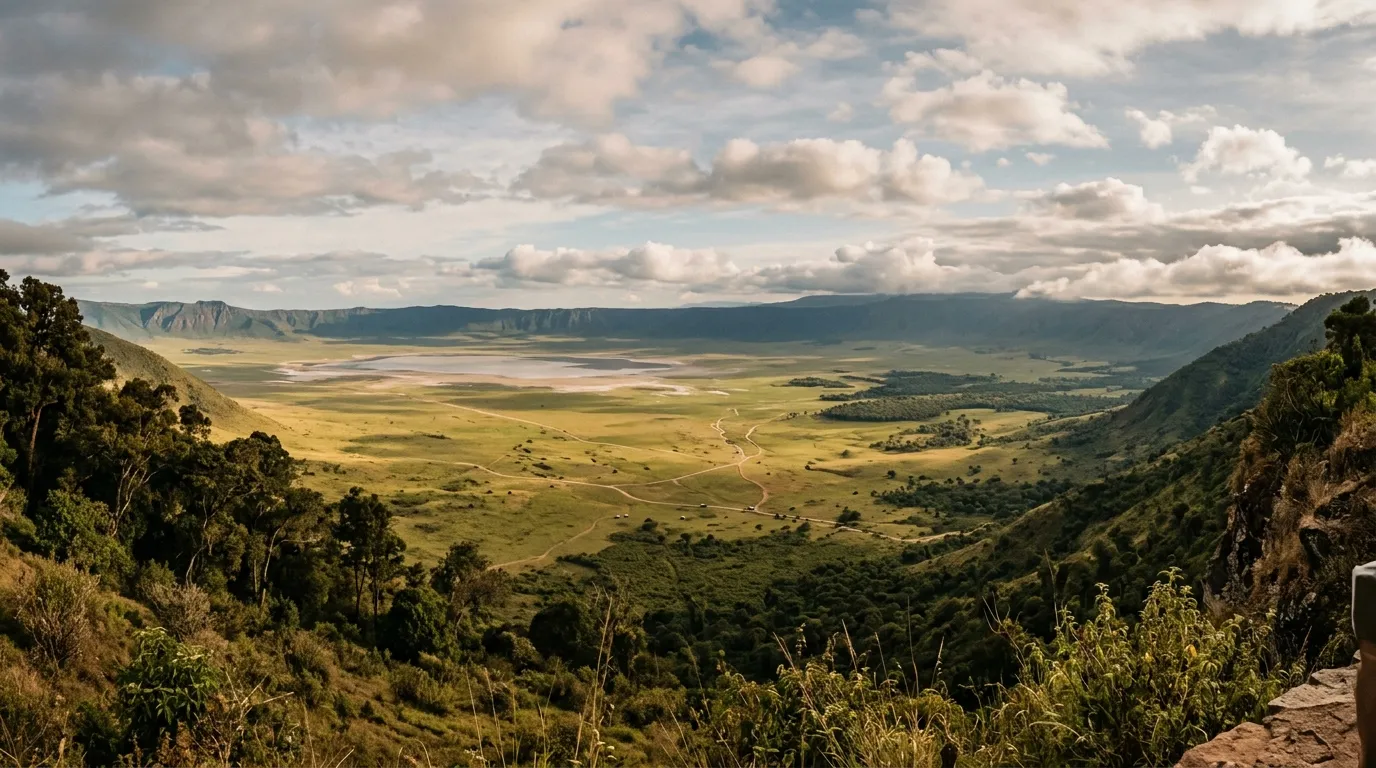
The forest thins as you approach 2,300 metres, the canopy opens, and then — suddenly and completely — the crater is there. The first viewpoint (Windy Point, 3.2100° S, 35.5783° E) gives you the full panorama: a flat floor extending 264 square kilometres below you, a soda lake glinting in the centre, green patches of the Lerai Forest, and the far rim 19 km away, partially obscured by the cloud that seems to permanently occupy the crater’s upper airspace. The scale is difficult to process. The brain knows it is looking at a collapsed volcano, but the eyes interpret it as a manufactured landscape — a colossal amphitheatre designed by someone with unlimited space and a preference for dramatic proportions.
Stop here. Get out of the vehicle. Let the altitude settle in your lungs (the air is noticeably thinner at 2,400 metres) and the view settle in your visual cortex. There will be other tourists at the viewpoint. Ignore them. The crater does not diminish with company.
The rim road
The rim road connects the eastern and western viewpoints, the lodge access roads, and the descent and ascent gates. It is approximately 12 km long, runs along the southern and southwestern rim, and passes through a mixture of forest and open grassland.
Road conditions
The rim road is packed earth — not gravel, not tarmac, just compacted soil that works perfectly when dry and becomes a slippery, traction-free surface when wet. In dry season (June to October), the road is straightforward: bumpy but firm, with occasional muddy patches where groundwater seeps across the surface. In wet season, the entire road can become a mud track that requires careful driving in low-range.
The specific hazard is the combination of mud and slope. The rim road is not flat — it rises and falls with the terrain, and some sections traverse side-slopes where a vehicle that loses traction will slide toward the outer edge. We drove it in June (dry season) and the traction was adequate. A guide we spoke to described February conditions as “exciting” with a tone that suggested the word was understatement.
Viewpoints
Three rim viewpoints are accessible from the road:
- Windy Point (eastern rim): The first viewpoint on the approach. Full crater panorama. Exposed to wind — the name is accurate.
- Lemala Viewpoint (southern rim): Looks directly down at the Lerai Forest and the hippo pool. Best for sunrise photography.
- Sopa Viewpoint (western rim): Wider angle including the crater’s northwestern wall. Adjacent to the Ngorongoro Sopa Lodge.
Each viewpoint has basic parking and a cleared area for standing. The edge is unfenced. The drop is 600 metres. Exercise the caution that this combination warrants.
The descent
Timing and logistics
The descent gate opens at 6:00 AM. We arrived at 5:50 and were third in a queue of approximately fifteen vehicles. The gate staff check your permits, record your registration number, and remind you of the 6-hour time limit on the crater floor. This limit is enforced — overstaying results in a fine.
The early start is not negotiable if you want the best experience. The first two hours after dawn are when the crater floor wildlife is most active, the light is most photographic, and the number of other vehicles is lowest. By 9:00 AM, the crater floor becomes busy. By 10:00 AM, popular spots like the hippo pool have five to ten vehicles clustered around them.
The descent road
The descent road drops 600 metres in approximately 5 km through a series of switchbacks cut into the crater wall. The gradient is steep — steep enough that low-range is required and engine braking is essential. Do not ride the brakes. The track is graded but narrow, with forest pressing in from both sides and the occasional tree root crossing the surface at angles designed to test suspension geometry.
The forest on the crater wall is different from the rim forest — denser, wetter, darker. Streams cross the road at two points, creating muddy sections that persist even in dry season. The descent takes approximately 30-40 minutes at a careful pace, which is the only appropriate pace. There is no overtaking, no turning back (it is one-way), and no room for error on the switchbacks. The reward for this concentration is the moment the forest opens at the bottom and you drive onto the crater floor into flat, open grassland with wildlife visible in every direction.
The crater floor
The circuit
The crater floor tracks form a rough loop of approximately 25 km, connecting the major wildlife areas. The surface is mostly savanna track — packed earth and grass, firm in dry season — with softer sections near the lake and the marshes. The tracks are reasonably well-defined but the junctions are poorly signed. A GPS with the crater floor tracks loaded is essential.
| Area | What you see | Notes |
|---|---|---|
| Lerai Forest | Elephants, monkeys, forest birds | Shaded driving, narrow tracks |
| Hippo Pool | Hippos (40-60 resident), waterbirds | Most popular stop, busy after 9 AM |
| Gorigor Swamp | Buffalo herds, crowned cranes, marsh birds | Soft edges — stay on the track |
| Lake Magadi (soda lake) | Flamingos (thousands, seasonally) | View from distance, track does not approach lake |
| Open plains (north) | Wildebeest, zebra, Thomson’s gazelle, lion | Classic savanna driving, best big cat area |
| Ngoitokitok Springs | Hippos, picnic area | Designated rest stop with basic facilities |
Wildlife
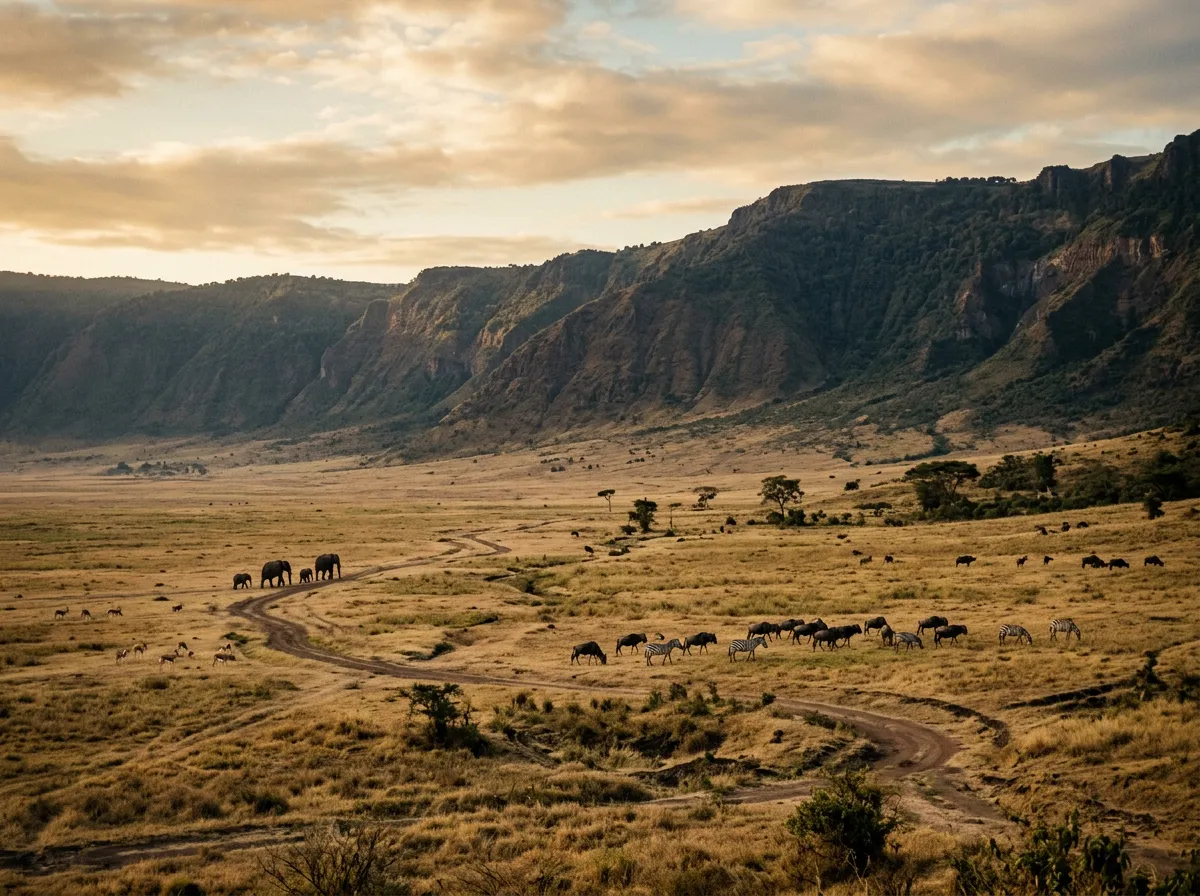
The crater floor contains an estimated 25,000 large animals in a 264 square kilometre space. The concentration is extraordinary. During our 5.5-hour circuit, we saw: lion (a pride of 8 resting near the Lerai Forest), elephant (a breeding herd of 12 in the forest), buffalo (too many to count — herds of 200+ on the open plains), black rhinoceros (two, distant, identifiable by horn profile — Ngorongoro is one of the best remaining locations for black rhino in Tanzania), leopard (one, in a tree on the forest edge, spotted by a guide in an adjacent vehicle who pointed it out to us), hippo (approximately 50 in the pool), flamingo (thousands on Lake Magadi), and a spotted hyena den with cubs at the entrance.
That is the Big Five in a single day. We did not set out to achieve this. The crater made it possible through sheer density.
Driving on the crater floor
The rules are simple and enforced: 25 km/h speed limit, no off-track driving, no exiting the vehicle except at designated picnic areas. The track edges are soft in places — particularly near the swamps and the lake — and vehicles that stray off the defined route risk getting stuck in black cotton soil. We saw one safari vehicle axle-deep in mud near Gorigor Swamp, with the guide standing outside looking at his phone, presumably calling for extraction.
Stay on the tracks. The crater floor is a conservation area within a conservation area, and the ecosystem is more fragile than the size suggests. The flamingo population on Lake Magadi depends on the lake’s chemistry, which depends on water flow from the crater walls, which depends on the vegetation on those walls not being disturbed. Everything is connected. Driving off-track is not just a fine — it is an act of measurable ecological damage.
The ascent
The ascent road is separate from the descent road and exits the crater on the western side. The gradient is similar — steep, switchbacked, forest-enclosed — and takes approximately 30-40 minutes in low-range. The ascent is mechanically easier than the descent (traction is less critical when climbing than when braking) but requires patience and low gear. Do not attempt to rush. The vehicle ahead of you is also climbing at 10 km/h and there is nowhere to pass.
At the top, the rim road returns you to the main NCA road and the route back toward Lodoare Gate.
Practical information
Costs
Ngorongoro is expensive. A breakdown for a self-drive vehicle with two people for one crater descent:
| Item | Cost (USD) |
|---|---|
| NCA entry fee (2 persons) | $140 |
| Vehicle fee | $40 |
| Crater descent fee | $295 |
| Total | $475 |
For a single day. This is the price of self-driving in one of Africa’s most iconic locations. The alternative — a guided safari from Karatu or Arusha — costs $300-600 per person and includes the same fees, a vehicle, a guide, and a packed lunch. The economics of self-driving only make sense if you value independence, you are combining the crater with a longer Serengeti trip using your own vehicle, or you have a group of four or more to split the crater fee.
Weather and clothing
The rim sits at 2,300-2,400 metres. Temperatures at dawn are 8-12 degrees Celsius — cold enough for a fleece and a windproof jacket. The crater floor at 1,800 metres is warmer (18-25 degrees Celsius) but can be windy. By midday, both the rim and floor warm considerably, and the afternoon sun on the floor can push past 30 degrees.
Fog is common on the rim, particularly in the morning. It can appear and disappear in minutes. Drive with headlights on whenever visibility is reduced.
Rain on the rim does not necessarily mean rain on the floor — the crater creates its own microclimate. However, rain on the descent road creates genuine difficulty: the steep gradients and forest shade mean the surface dries slowly, and a wet descent road is a test of braking control and nerve.
Timing your visit
If driving a single day: arrive at the descent gate by 6:00 AM. Spend 5-5.5 hours on the crater floor (leaving 30 minutes buffer before the 6-hour limit). Ascend by 12:00-12:30 PM. Drive back to Karatu for lunch, or continue to the Serengeti.
If staying on the rim: the NCA has lodges (\(\)) and a public campsite at Simba Camp (3.2033° S, 35.5617° E). The campsite is basic — flat ground, a long-drop toilet, and a view that is worth more than any lodge room we have occupied. Temperature at night drops to near freezing. Bring a sleeping bag rated to 0 degrees Celsius.
Getting there and combining with other routes
The Ngorongoro Conservation Area is on the main route between Arusha/Karatu and the Serengeti. If you are driving to the Serengeti Western Corridor, you will pass through the NCA regardless — the Serengeti’s Naabi Hill Gate is 100 km beyond the crater. This makes Ngorongoro a natural first stop on a northern Tanzania circuit.
From Karatu: 35 km to Lodoare Gate, paved road. 18 km gate to rim, graded gravel. Total approach: about 1.5 hours.
For the full Tanzania off-road experience, combine Ngorongoro and the Serengeti with Ruaha River Crossings in the south. The transfer between the northern and southern parks requires a day of highway driving via Dodoma or Iringa — approximately 700 km. This is not scenic driving. It is the connecting tissue between two extraordinary driving experiences.
The honest summary
Ngorongoro is not a long drive or a difficult one. It is 65 km of moderate terrain that you will complete in a single day. What makes it exceptional is concentration — of wildlife, of geological drama, of the specific feeling that comes from driving a vehicle into a collapsed volcano and finding an entire functioning ecosystem living on its floor. The descent through the forest, the fog on the rim, the moment the crater opens below you — these are driving experiences that have no equivalent.
The cost is real. The crowds after 9 AM are real. The time limit is enforced. Plan accordingly, arrive early, and bring warm clothing. The crater does not care about your budget, but it will repay your effort with a day you will not forget.