Skeleton Coast Route
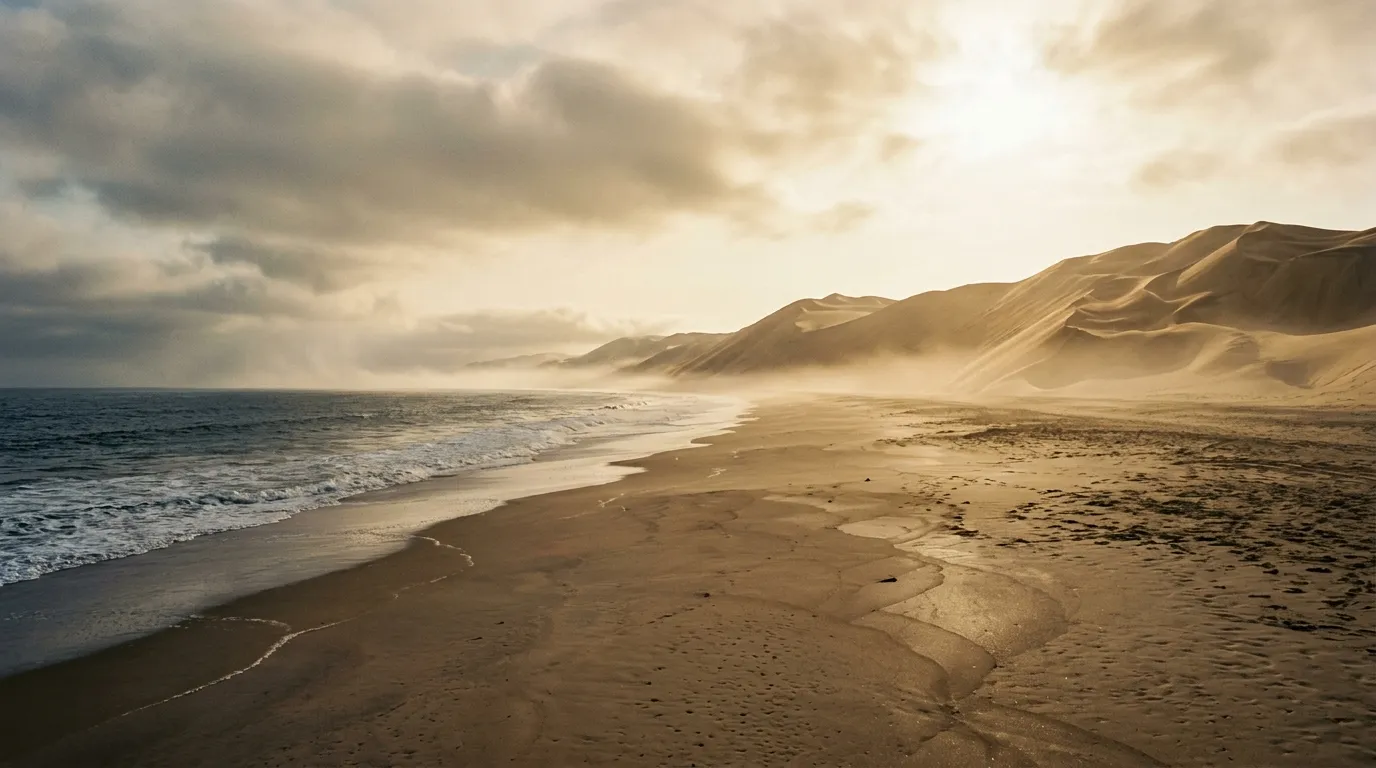
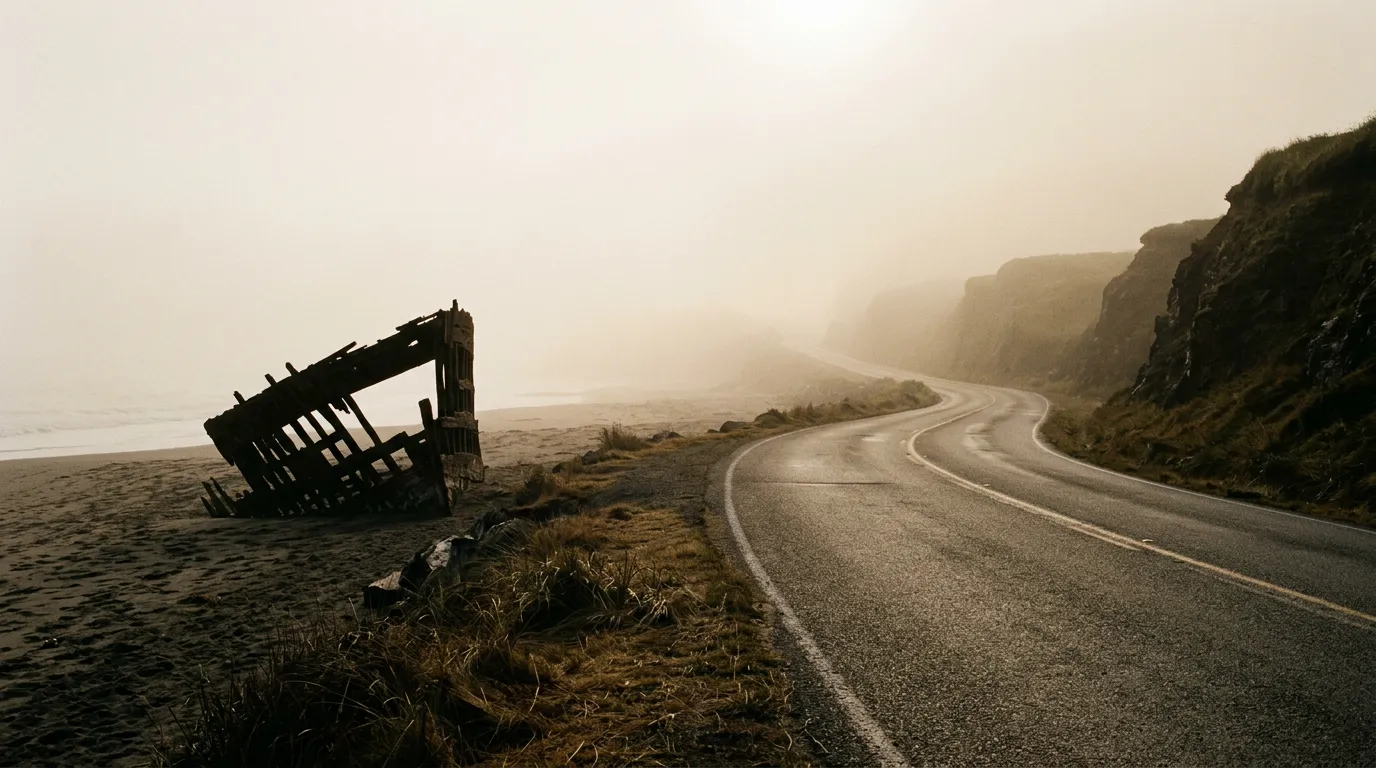
The fog came in from the Atlantic at about 09:00, which is when fog comes in on the Skeleton Coast on most days between November and February, and also on a surprising number of days in the other eight months. One moment we were driving on a white salt road with the ocean visible as a dark line to the left and the desert visible as a pale line to the right. The next, both disappeared. The world contracted to a circle of about 50 metres — white road surface below, grey air on all sides, and the occasional dark shape materialising ahead that was either a rock, a sand dune, or one of the shipwrecks that give this coast its name. We drove with headlights on, at 40 km/h, for the next two hours. The silence was remarkable. The Skeleton Coast in fog is not a landscape; it is an absence of landscape, and the driving becomes an act of faith in the continued existence of the road surface.
The Skeleton Coast runs approximately 500 km along Namibia’s Atlantic shore, from the Kunene River in the north to the Ugab River in the south. The name comes from the shipwrecks — over a thousand vessels have gone down on this coast, victims of fog, currents, and the offshore rock shelves that do not appear on charts until they appear under your hull. The survivors who made it to shore found themselves in the Namib Desert, with no water, no food, and hundreds of kilometres of sand between them and any settlement. The coast earned its name honestly.
The driveable section — the C34 highway from Henties Bay to Terrace Bay — covers 250 km of the southern coast. Beyond Terrace Bay, access is restricted and requires a permit from Namibia Wildlife Resorts. We drove the C34 section, with side trips to Cape Cross and several marked viewpoints, over two and a half days.
Route overview
The route is linear — north from Henties Bay to Terrace Bay — rather than a loop. This means either retracing your steps or continuing north into restricted territory (permit required) and exiting via the Palmwag road into Damaraland. We did the latter, which combined this route with the Damaraland Elephant Tracks.
| Section | Distance | Terrain | Key features |
|---|---|---|---|
| Henties Bay to Cape Cross | ~65 km | Salt road, gravel | Cape Cross seal colony, first shipwrecks |
| Cape Cross to Skeleton Coast gate | ~35 km | Salt road | Park entry, coastal scenery |
| Skeleton Coast gate to Mile 108 | ~50 km | Salt road, sand patches | Shipwrecks, fishing camps |
| Mile 108 to Torra Bay | ~50 km | Salt road, rougher surface | Desolate section, no facilities |
| Torra Bay to Terrace Bay | ~50 km | Gravel, improved | Terrace Bay fuel and accommodation |
Total: approximately 250 km. Driving time without stops: 4-5 hours. Recommended time: 2-3 days.
Section 1: Henties Bay to Cape Cross
Henties Bay
Henties Bay is the last outpost of normality before the Skeleton Coast. It is a fishing town of about 6,000 people, stretched along a beach that the cold Benguela Current makes unsuitable for swimming but apparently ideal for shore fishing. The town has fuel, a supermarket, basic accommodation, and a population that regards the desert to the north with the calm familiarity of people who live next to something that would alarm visitors.
Fill your tank here. Completely. Check your tire pressures. Buy water if you have not already. The next reliable fuel is Terrace Bay, 250 km north, and “reliable” in this context means “the pump works most of the time.”
The salt road
North of Henties Bay, the C34 becomes a salt road — a surface made of compacted salt and gravel that is surprisingly hard and surprisingly fast. In good conditions, you can drive at 80-100 km/h. The temptation to drive faster is strong: the road is straight, the surface is smooth, and there is nothing to slow you down except the horizon. Resist this temptation. The salt road has two enemies: corrugation and fog.
Corrugation is the washboard pattern that develops on unpaved surfaces from repeated traffic. On the C34, it accumulates in sections and can be severe enough to shake fittings loose, crack windscreens, and separate your fillings from your teeth. The standard technique is to find the “sweet spot” speed where the tires skip across the tops of the corrugations rather than dropping into each trough. On the C34, this speed is approximately 60-70 km/h. Above 70, the vibration increases. Below 50, you feel every individual ridge. At the sweet spot, the ride is bumpy but manageable.
Fog, as described, reduces visibility to 50 metres or less. When fog and corrugation coincide, you are driving on a vibrating surface toward things you cannot see. Headlights on. Speed down. Patience up.
Cape Cross seal colony
Cape Cross (21.7667° S, 13.9500° E) is approximately 65 km north of Henties Bay. It is a small headland where, depending on the season, between 80,000 and 200,000 Cape fur seals haul out on the beach to breed, nurse their pups, and produce a smell that reaches your vehicle several kilometres before the colony is visible.
The smell requires comment. It is not bad in the way that a rubbish bin is bad. It is overwhelming in the way that a biological process involving 100,000 animals in a confined space is overwhelming. It is an olfactory wall. Some visitors last twenty minutes. Some last five. We lasted about forty minutes, which was enough to walk the boardwalk that runs through the colony and appreciate the scale of what we were seeing: thousands of animals on every visible surface — rock, sand, each other — barking, fighting, nursing, sleeping, and collectively producing a noise level that makes conversation difficult. The seals are fascinating. The experience is intense. The memory is primarily nasal.
The colonial history of Cape Cross is also present: a stone cross marks the point where Portuguese explorer Diego Cao landed in 1486 and erected a padrao — a stone pillar claiming the territory for Portugal. The pillar has been replaced by a replica. The seals, one assumes, were unimpressed by the original claim.
Entry fee: 80 NAD per person (approximately 4.50 USD).
Section 2: Cape Cross to Torra Bay
The Skeleton Coast Park gate
About 100 km north of Henties Bay, a gate marks the entrance to the Skeleton Coast Park. The gate is staffed, and you will need to show your vehicle registration and driver’s license. For the section between the gate and Terrace Bay, no advance permit is required — you pay an entry fee at the gate (80 NAD per person). Beyond Terrace Bay, a permit from NWR is mandatory.
The shipwrecks
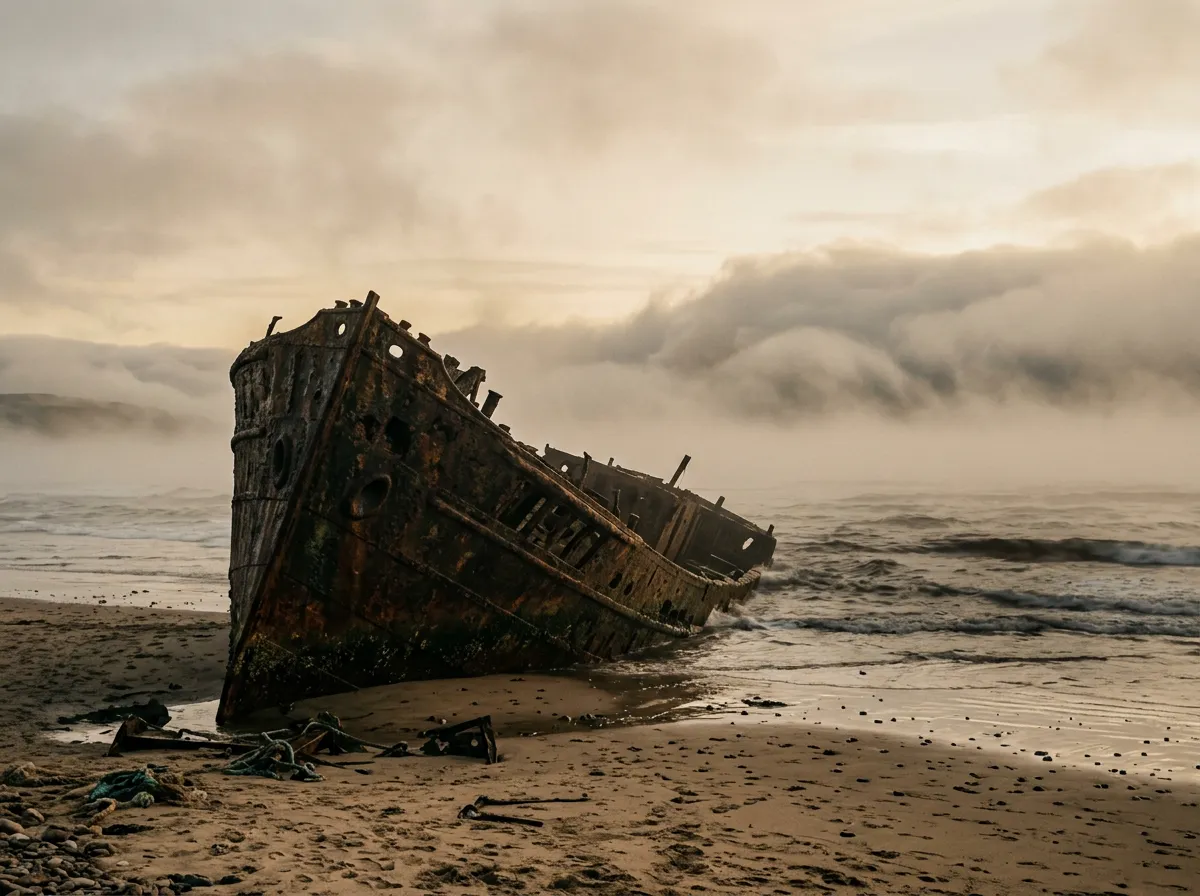
Between the park gate and Torra Bay, the coast delivers on its name. Shipwrecks appear at intervals along the shore — some visible from the road as dark shapes in the sand, others requiring a short walk from marked turnoffs. The wrecks range from recent fishing vessels to century-old steamers, all in various stages of being reclaimed by the desert. Sand is burying them incrementally. Metal is rusting. Wood is bleaching. Each wreck is a little less wreck and a little more landscape than it was the previous year.
The most photogenic wreck we found was approximately 140 km north of Henties Bay — a steel-hulled vessel lying on its side about 200 metres from the road, half-buried in sand, with the fog wrapping around it in a way that made it look like a still from a film about the end of civilisation. We photographed it for twenty minutes and then realised we had not checked the map and had no idea which ship it was. This is typical of the Skeleton Coast: the wrecks are poorly documented, inconsistently signed, and appear without warning. You drive, and periodically a ship emerges from the fog, and you stop and look at it and wonder about the people who were on it, and then you drive on.
The emptiness between
The sections between landmarks — between Cape Cross and the wrecks, between the wrecks and Torra Bay — are defined by emptiness. The salt road runs straight. The ocean is a constant presence to the west, sometimes visible, sometimes not. To the east, the Namib Desert extends inland as a gravel plain that eventually becomes sand dunes, which eventually become the central highland. There is nothing to mark the distance except the kilometre posts — small white markers that count upward from Henties Bay and provide the Skeleton Coast’s informal navigation system. “Mile 108” and “Mile 72” are place names here, in a landscape where more conventional naming would require something to name.
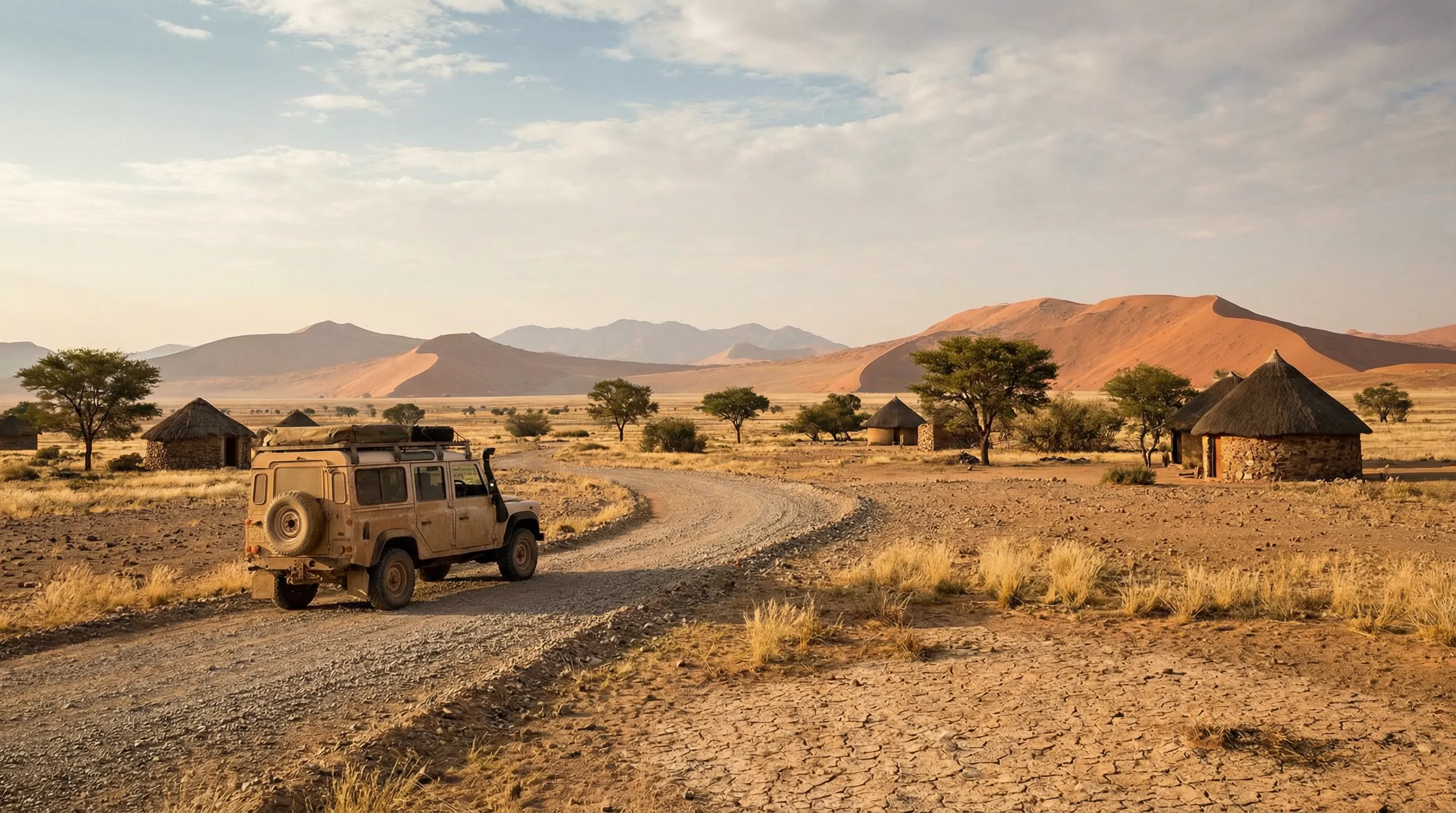
The monotony is deliberate. It is also, after an hour or so, oddly compelling. Your attention narrows to the road surface, the fog conditions, the fuel gauge, and the occasional animal track crossing the salt — jackal, hyena, gemsbok, all of whom live in the gravel desert east of the road and visit the coast for reasons of their own. The Skeleton Coast is not a scenic drive in the conventional sense. It is an endurance drive through a landscape whose beauty is in its refusal to perform.
Section 3: Torra Bay to Terrace Bay
Torra Bay
Torra Bay is a seasonal fishing camp — open to the public during December and January, closed the rest of the year. When open, it has basic camping facilities and a small shop. When closed, it is a collection of wind-blasted structures that look as abandoned as the shipwrecks. We passed through in June. It was closed.
The final 50 km
The road from Torra Bay to Terrace Bay improves from salt to gravel, and the coastal landscape develops a little more drama — rocky headlands, sheltered bays where seals congregate in smaller numbers, and the occasional view inland where the fog clears enough to reveal the first sand dunes of the Namib proper.
Terrace Bay
Terrace Bay (19.9667° S, 13.0333° E) is the end of the accessible Skeleton Coast and the beginning of the restricted northern section. It is also one of the most surreal settlements we have visited in any country. A small NWR-operated rest camp sits on the shore, offering basic accommodation (rondavels and camping), a restaurant, and — critically — a fuel pump. The fuel pump at Terrace Bay is the loneliest operational fuel pump in Namibia. It services the trickle of self-drivers who make it this far north and the fishing enthusiasts who base themselves here for the shore fishing, which is apparently excellent. We did not fish. We filled our tank, ate a meal of questionable provenance but welcome warmth, and slept in a rondavel while the fog pressed against the windows.
Terrace Bay fuel price: approximately 10% above Windhoek prices. The markup is for logistics, and it is fair.
Equipment checklist
| Item | Required | Notes |
|---|---|---|
| Full fuel tank + 20L jerry can | Yes | 250 km between Henties Bay and Terrace Bay |
| Water (5L per person per day) | Yes | No potable water between towns |
| Warm clothing | Yes | Coastal fog drops temperatures to 10-15°C even in summer |
| Headlamp / torch | Yes | Fog + dusk = no visibility |
| Tire pressure gauge | Yes | Salt road conditions vary; check twice daily |
| 2 spare tires | Recommended | Salt road edges can hide sharp objects |
| GPS / offline maps | Yes | No cell signal. Mile markers are the main navigation reference. |
| Binoculars | Recommended | For shipwrecks and wildlife at distance |
Fuel and logistics
The fuel equation for this route is simple: 250 km from Henties Bay to Terrace Bay, with nothing in between. Our Toyota Hilux consumed approximately 13L/100km on the salt road — slightly above highway average due to the surface resistance and the occasional deep sand patch. On 250 km, that is roughly 33 litres. With an 80L tank full at Henties Bay, we had ample reserves. Smaller tanks need the jerry can.
| Location | Fuel | Food/water | Accommodation |
|---|---|---|---|
| Henties Bay | Yes | Supermarket, restaurants | Hotels, guesthouses |
| Cape Cross | No | Small kiosk (unreliable) | No |
| Skeleton Coast gate | No | No | No |
| Torra Bay | No (seasonal) | Small shop (seasonal) | Camping (Dec-Jan only) |
| Terrace Bay | Yes | Restaurant (NWR) | Rondavels, camping |
Seasonal considerations
The Skeleton Coast is driveable year-round, but conditions vary significantly.
| Season | Fog | Temperature | Wind | Recommendation |
|---|---|---|---|---|
| Nov – Feb | Frequent, dense | 15-25°C (coast), 35°C+ (inland) | Moderate | Atmospheric but limited visibility |
| Mar – May | Moderate | 15-20°C | Light | Best balance of visibility and comfort |
| Jun – Aug | Occasional | 10-18°C | Cold | Clear views but cold nights |
| Sep – Oct | Light | 15-22°C | Moderate | Good conditions, approaching summer fog |
The fog is the defining weather feature. It forms when warm air from the interior meets the cold Benguela Current offshore, and it can persist for days. When it lifts, the Skeleton Coast is stark and bright and the views extend for kilometres. When it descends, the coast becomes something else entirely — enclosed, quiet, and navigable only by road surface and compass heading.
Getting there and getting out
From Windhoek: 290 km to Henties Bay via the B2 (tarred). About 3.5 hours.
From Swakopmund: 75 km to Henties Bay via the B2. About 1 hour. Swakopmund is the more common starting point and has better supplies.
Continuing north: Beyond Terrace Bay, the Skeleton Coast Park continues north for another 250 km to the Kunene River. This section requires a permit from NWR, booked well in advance, and is fly-in only for most visitors. Self-drive permits are extremely limited.
Continuing east: From Terrace Bay, a gravel road leads inland to Palmwag and Damaraland. This is the connection to the Damaraland Elephant Tracks route, and it is how we exited the coast. The road climbs from sea level to about 800 metres over 200 km of gravel through increasingly dry terrain.
The Skeleton Coast also connects logically to the Sossusvlei approaches if you return south via Henties Bay and take the C14 inland. For coastal driving in a different climate, Oman’s coast road offers desert-meets-ocean scenery in a warmer register.
The honest summary
The Skeleton Coast is not exciting. It is not dramatic in the way that mountain passes are dramatic or river crossings are dramatic. It is a long, straight road through fog and sand, punctuated by things that are dead — ships, whales, the occasional seal — and things that are very much alive — the Cape Cross colony, the jackals, the gemsbok that materialise from the fog and vanish again. The driving is physically easy and psychologically strange. You drive north, into increasing emptiness, and the normal referents of a road trip — towns, services, other vehicles, phone signal — fall away one by one until there is nothing left except the road and the coast and the fog.
We found this compelling. Some people will not. The Skeleton Coast rewards those who are interested in landscape as a process — erosion, deposition, the slow work of ocean and wind on sand and metal — rather than landscape as a spectacle. It is quiet, it is slow, and it smells, at Cape Cross, considerably worse than any other place we have driven through on any continent.
Drive at 60 km/h. Carry warm clothes. The fog will lift. Eventually.